research
What makes a cell what it is? How does it know where it is in the body? And how does it stay that way, reliably, across the lifetime of an organism? These are among the oldest questions in biology, and they remain mostly unsolved at the mechanistic level.
Our lab approaches these questions through the genome. Specifically, we study the gene regulatory networks that control how genetic information is read out during development: which genes are turned on, in which cells, and in response to which signals. We work across vertebrate model systems and in engineered cell platforms, combining genomics, live imaging, and synthetic approaches to move from describing development to understanding and rebuilding it.
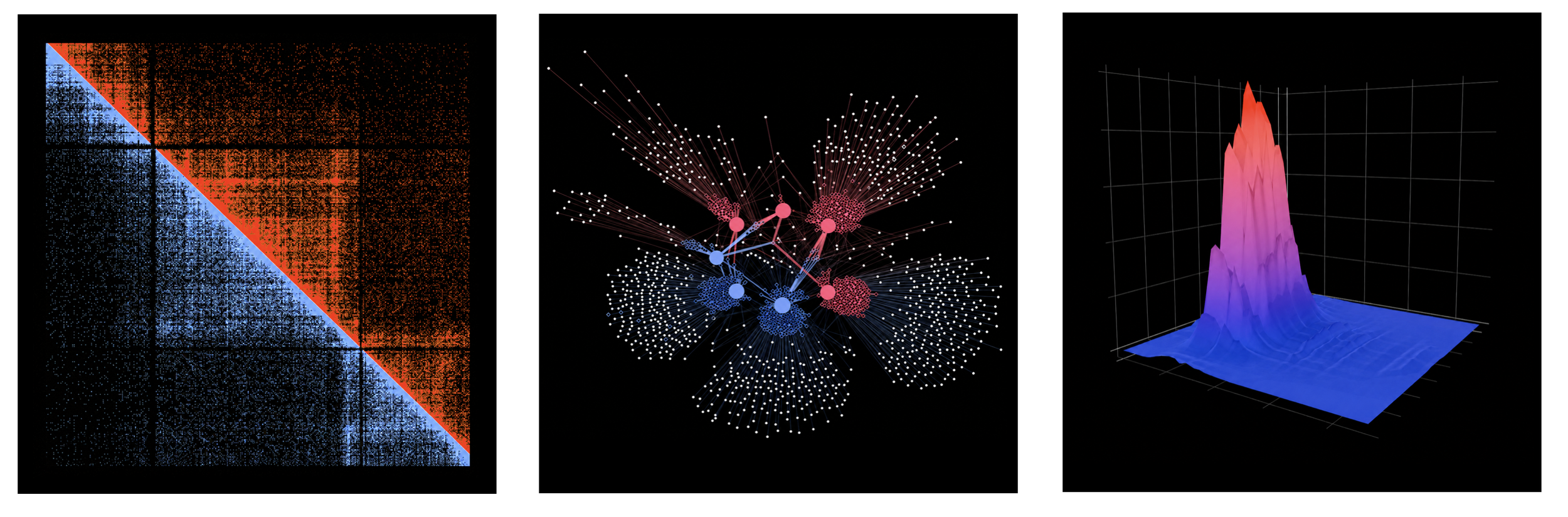
Molecular Control of Cell Identity
Every cell in the body contains the same genome, yet different cell types activate distinct regulatory programs that define their identity and behavior. We investigate how these programs are established, stabilized, and remodeled during development.
Our work focuses on the cis-regulatory elements, transcription factors, and chromatin mechanisms that control developmental gene expression. By mapping enhancer activity and reconstructing gene regulatory networks, we examine how embryonic cells transition between cellular states and how these processes are altered in disease.
We are particularly interested in developmental plasticity - how cells maintain the capacity to change identity - and how these mechanisms can be harnessed for cellular reprogramming and regenerative biology.
Spatial Control of Development
Development depends not only on which genes cells express, but also on where and when those genes are activated. We study how positional information is interpreted by the genome to generate spatially organized patterns of gene expression during embryogenesis.
Using spatial genomics and functional approaches in vertebrate embryos, we investigate how signaling pathways establish distinct developmental territories in structures such as the neural crest and embryonic organizer. Our work examines how enhancer logic, chromatin accessibility, and genome topology convert extracellular signals into precise transcriptional outputs.
These studies aim to uncover the genomic mechanisms that build complex tissues and establish body-plan organization during early development.
Genome–Environment Interactions
The genome continuously responds to information from the cellular environment. We investigate how metabolic states, mechanical forces, and environmental signals influence chromatin organization and developmental gene regulation.
Our work has shown that changes in cellular metabolism can directly remodel enhancer activity and epigenetic landscapes, altering developmental programs and cell fate decisions. We are particularly interested in understanding how environmental inputs are integrated into gene regulatory networks during periods of developmental transition and morphogenesis.
By defining how the genome senses and responds to its environment, we aim to uncover mechanisms linking development and disease.
.
Synthetic Developmental Biology
Understanding development also means being able to rebuild it. We are increasingly using organoids, stem cell models, and engineered cell systems to reconstruct developmental processes in the lab, moving from observation toward prediction and design.
These approaches let us test regulatory principles in controlled settings, perturb gene regulatory networks with precision, and ask whether our models of development are truly mechanistic. We are applying these tools to questions about cell fate transitions, tissue patterning, and the regulatory basis of congenital disease.
Our long-term aim is to develop a deep enough understanding of developmental gene regulation that we can use it to engineer cell identities, model human developmental disorders, and lay the groundwork for regenerative approaches.